
🏰 Proceno, the hidden gem of the Tuscia region
- Giano di Vico

- Nov 5, 2025
- 4 min read
There is a village, up on the border between Lazio and Tuscany, that seems to have stepped out of an ancient tale. Proceno, suspended between the Paglia Valley and the Volsini Mountains, preserves the memory of an Etruscan past, the breath of medieval castles, and the gentle calm of places that are never in a hurry.
📍 Where it is
Set on a hill 418 meters above sea level, Proceno is in the province of Viterbo and has just over 600 inhabitants. It lies near Acquapendente (3 km as the crow flies) and 63 km from Viterbo. The village overlooks the confluence of the Paglia River and the Stridolone stream, a natural vantage point that once controlled the passes between Lazio, Tuscany, and Umbria. Today it is part of the “Authentic Villages of Italy,” and its discreet charm has remained intact.

🚗 How to get there
By car: about 56 km from Viterbo (≈55 minutes); just 3 km from Acquapendente. The A1 Orvieto exit is 30 km away.
By bus: daily Cotral services between Viterbo and Acquapendente (about 1 hr 5 min), then local shuttles to Proceno.
By plane: the nearest airports are Rome and Perugia, both about 1 hr 30 min away.

🏺 History and legends
The origins of Proceno fade into antiquity, between Etruscan history and myth. One legend tells that Porsenna, king of Chiusi and lucumo (Etruscan ruler), while hunting in the woods between the Paglia and the Stridolone, faced a legendary wild boar. The beast froze in mid-air and fell at his feet—a sign from the Goddess Uni. On the hill of the prodigy, Porsenna raised a stele and founded a settlement called “Procenum.”
In 976 the village passed under Orvieto; it was then fortified by Pope Gregory V (997), destroyed by the troops of Henry IV (1083), and rebuilt in 1097. In the sixteenth century it was ruled by the Sforza, then by the Mozzanti and the Selvi, and finally returned to the Papal States until Italian unification. According to tradition, Saint Agnes Segni received here the consecrated Host from an angel—an episode still alive in local devotion today.

🏰 What to see in Proceno
🏯 The Medieval Fortress
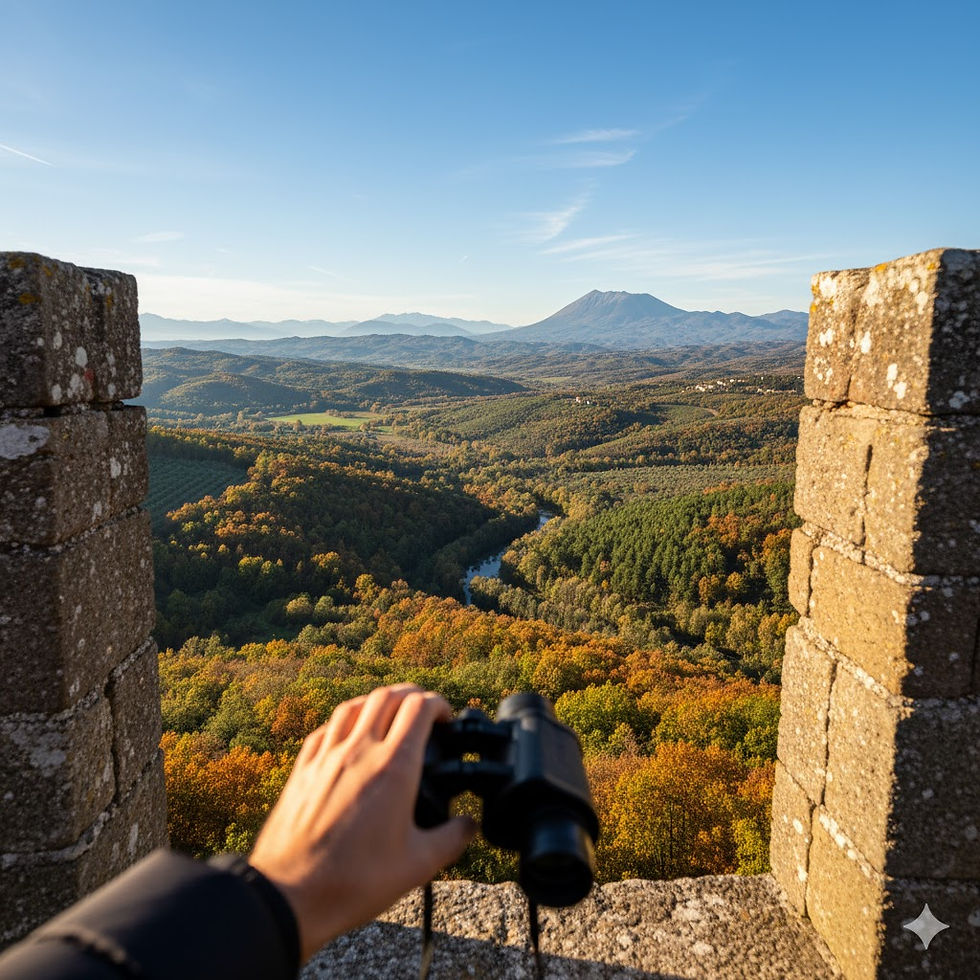
Built on a spur of volcanic rock, the fortress dominates the village with its defensive architecture: crenellated walls, three towers, arrow slits, and a single entrance gate. It is one of the few medieval castles in Lazio still intact. From the top, the view sweeps over chestnut woods rich in mushrooms, all the way to Mount Amiata and Civitella d’Agliano. Today it hosts events and guided tours that recreate the village’s medieval life.

🏛️ Sforza Palace
Built in 1550 by Cardinal Guido Ascanio Sforza—probably to a design by Antonio da Sangallo the Younger—the palace preserves splendid Renaissance frescoes inspired by the Old Testament and Etruscan legends. On the upper floors you’ll find the Museum of Rural Life, which tells the story of Tuscia’s countryside between the 19th and 20th centuries.

⛪ The churches
Church of Saint Agnes: a circular building erected on the ruins of an ancient monastery. Next to it, the “Monastery Garden” with a centuries-old olive tree, where the saint is said to have received the Eucharist from an angel ten times.
San Martino: a simple 13th-century Gothic structure in tuff, with frescoes from the 14th–15th centuries.
Santa Maria del Giglio: built in the 16th century, it preserves remnants of frescoes and fragments of older decorations.

🌳 Trails & nature
Proceno is a great starting point for slow, scenic hikes:
Mills Trail (8 km): follows the Paglia River past old watermills, woods, and clearings.
Towers Route: links Proceno to other Via Francigena villages, with ridge paths and breathtaking views.
Perfect for lovers of slow trekking and autumn photography.

🍷 Traditions & flavors
Proceno is famous for its Red Garlic—a symbol of authenticity and rural pride. It has perfectly shaped bulbs, an intense aroma, and a bold flavor. It’s used in traditional dishes such as lamb with red garlic, garlic-infused butter, and Proceno-style beans. Among the sweets, the standout is the Biscotto di Sant’Antonio, hand-braided and scented with anise. Every year, during the Red Garlic Festival, the village fills with aromas and food stalls that showcase the area’s identity.

🕊️ Proceno and the Via Francigena
The Via Francigena crosses Proceno like a vein of ancient time. Travelers can choose between two variants:
a valley route, gentler and more flowing,
or a mountain route, more demanding yet rich in spectacular views.
Proceno welcomes both with sincere hospitality and a human pace. Here every stone recalls a pilgrim’s passing, every doorway is an invitation. A place where history, nature, and spirituality weave into a single experience of medieval authenticity.
✍️ Viterbolandia reflects
Proceno does not ask to be discovered: it waits, like places that know the value of time. Walking its streets, you sense the measure of true things—the stone, the air, the unhurried step. And when the journey along the Francigena leads you here, it feels like arriving at a place that doesn’t end, but keeps on walking within you.
📍 Main sources: Borgoproceno · Lazio Nascosto · E-Borghi · Wikipedia · Comune di Proceno · Alisei Trek · VieFrancigene.org
Giano di Vico per Viterbolandia


Comments