
🏺 The Etruscan Necropolises of Cerveteri and Tarquinia: a journey through life, memory, and cultural management
- Giano di Vico

- Aug 22, 2025
- 4 min read
Di Giano di Vico – Viterbolandia
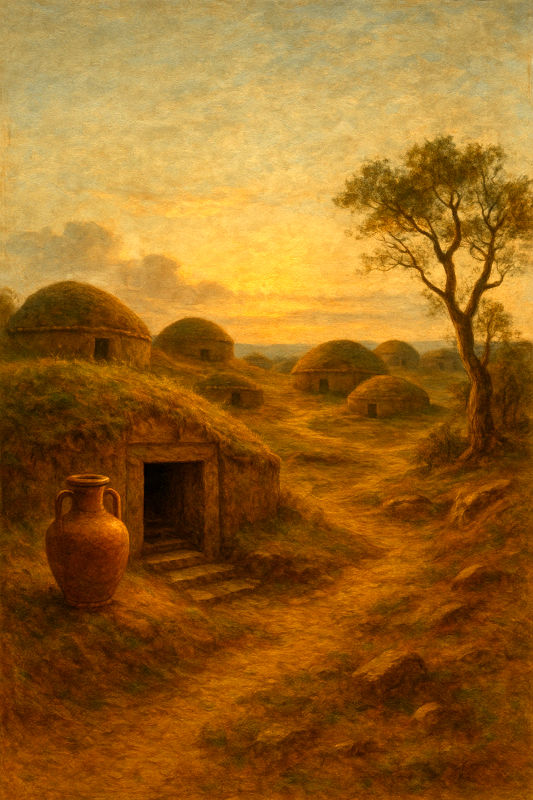
In the heart of Tuscia, where the green of tufa stone blends with the blue of the Tyrrhenian Sea, there are invisible cities. They are not cities of the living, but of memory: Etruscan necropolises that have told a story spanning nine centuries. In these “cities of the dead,” the life of the Etruscans is carved in stone and painted on rock.
Today, the Archaeological Park of Cerveteri and Tarquinia invites us on a business-oriented journey: because culture, dear readers, is the only start-up that never faces a crisis.
🌳 Banditaccia – the city of tufa
Let’s begin with Cerveteri. The Banditaccia necropolis (197 hectares) reproduces the urban structure of a city with streets, squares, and districts. Walking here feels like leafing through a textbook on Iron Age urban planning. Each mound is a single-family villa, each corridor an access road. Between the 7th and 4th centuries BC, the necropolis held around 20,000 chamber tombs carved into the tufa. The residential model is carefully replicated: hut-shaped tombs evoke the earliest wooden houses; large circular tumuli with multiple chambers celebrate aristocratic clans.
Our Etruscan archeo-managers spared no expense:
🏺 Tomb of the Greek Vases – holds imported ceramics, proof of intense trade relations.
🏛️ Tomb of the Capitals – reproduces a domus with columns and capitals.
🎭 Tomb of the Reliefs – masterpiece of the Matuna family, with thirteen matrimonial niches and vividly painted stucco reliefs. It feels like a design showroom: weapons, utensils, red cushions, and pets sculpted to remind us that the afterlife was just another room in the house.
The overall impression? That of a real city, divided into blocks and neighborhoods, where memory is not melancholy but architecture. Even Renaissance influencers understood this: Michelangelo visited Cerveteri and drew inspiration from it. Forget coworking brainstorms!
🎨 Monterozzi – the painted theater
From tufa we move to color. In Tarquinia, the Monterozzi necropolis stretches over 75 hectares and preserves about 200 painted tombs. These hypogeal chambers are true art galleries: frescoes capturing banquets, hunts, and games, allowing us to step into Etruscan homes, watch diners reclining on klinai while musicians play and servants wait. It’s an ante-litteram documentary accompanying the deceased on their journey to the afterlife.
Among the masterpieces:
🦁 Tomb of the Leopards (4th century BC) – a chamber with a double-pitched roof where spotted leopards watch over scenes of dancing, birds, and dolphins.
🎣 Tomb of Hunting and Fishing – celebrates earthly pleasures with men fishing and hunting among waves and rocks.
👑 Doganaccia – at the heart of the necropolis, this area holds the tumuli of the King and Queen (40 m in diameter), a testimony to the aristocratic power of the 7th century BC.
Tarquinia was the Hollywood of the Etruscans and, like any respected creative hub, attracted illustrious visitors: beyond Michelangelo, Johann Winckelmann was also enraptured by colors that have survived for more than 2,500 years.
💡 Why they matter – value and vision
Why should we care about cemeteries? The answer lies in ROI – Return On Imagination. These necropolises are the only complete testimony of the Etruscan civilization. They represent the birth of urban culture in the western Mediterranean and taught the Romans how to design streets, houses, and rituals. Tarquinia’s frescoes are masterpieces of creativity; Cerveteri’s tumuli transcribe in stone the very floorplan of the cities of the living.
As cultural heritage managers, we must recognize their strategic value. These sites generate a steady flow of visitors, create local employment, and position Tuscia on the world map. But they are fragile: erosion and mass tourism can damage frescoes and structures. That’s why the authorities have defined strict conservation policies, with limited access and micro-climate controls. An ESG approach avant la lettre.
🧰 How to organize your visit – a traveler’s toolkit
Every successful project needs an action plan. Here are a few practical tips to turn your curiosity into a memorable visit.
📍 Where they are
Banditaccia: Cerveteri (Rome province), about 50 km from Rome and one hour’s drive from Viterbo.
Monterozzi: Tarquinia (Viterbo province), 80 km north of Rome and 20 km from Civitavecchia.
🕒 When to go
The necropolises are open year-round, but schedules vary. In summer, visit early in the morning or at sunset to avoid the heat and enjoy perfect light. Some painted tombs in Tarquinia are accessible only by reservation with limited entry.
🎟️ Tickets
The Archaeological Park offers combined tickets including the necropolis and the National Archaeological Museum of Cerveteri or Tarquinia. Always check updated prices and reductions on the official website.
🚗🚆 How to get there
By car: from Rome take the A12 toward Civitavecchia; exit at Cerveteri–Ladispoli for Banditaccia, or Tarquinia for Monterozzi.
By train: regional lines Rome–Civitavecchia (Marina di Cerveteri station + bus) and Rome–Pisa (Tarquinia station).
By bus: Cotral services connect Viterbo with Cerveteri and Tarquinia.
🧳 Practical tips
🥾 Wear comfortable shoes and bring water, a hat, and sunscreen.
📷 Don’t touch the frescoes or use flash: strong light damages pigments.
🎧 Use the audio guide or rely on an expert guide to catch every detail.
🧡 Be respectful: you are guests in homes over two thousand years old.
📜 Conclusion
The necropolises of Cerveteri and Tarquinia are not just ancient cemeteries; they are incubators of culture and emotional databases where daily life intertwines with the afterlife. They remind us that our cities, our rituals, and even the way we design public spaces owe something to a vanished people.
Come walk among these stones and listen to the stories they whisper. Memory is never a cost, but an investment in the future.
— Giano di Vico


Comments